Jump to: Children at the Jacksonville Women’s March or At 81, he wants to be the oldest man to sail solo, non-stop around the world
Five years later: Protestors remember Trayvon Martin’s death
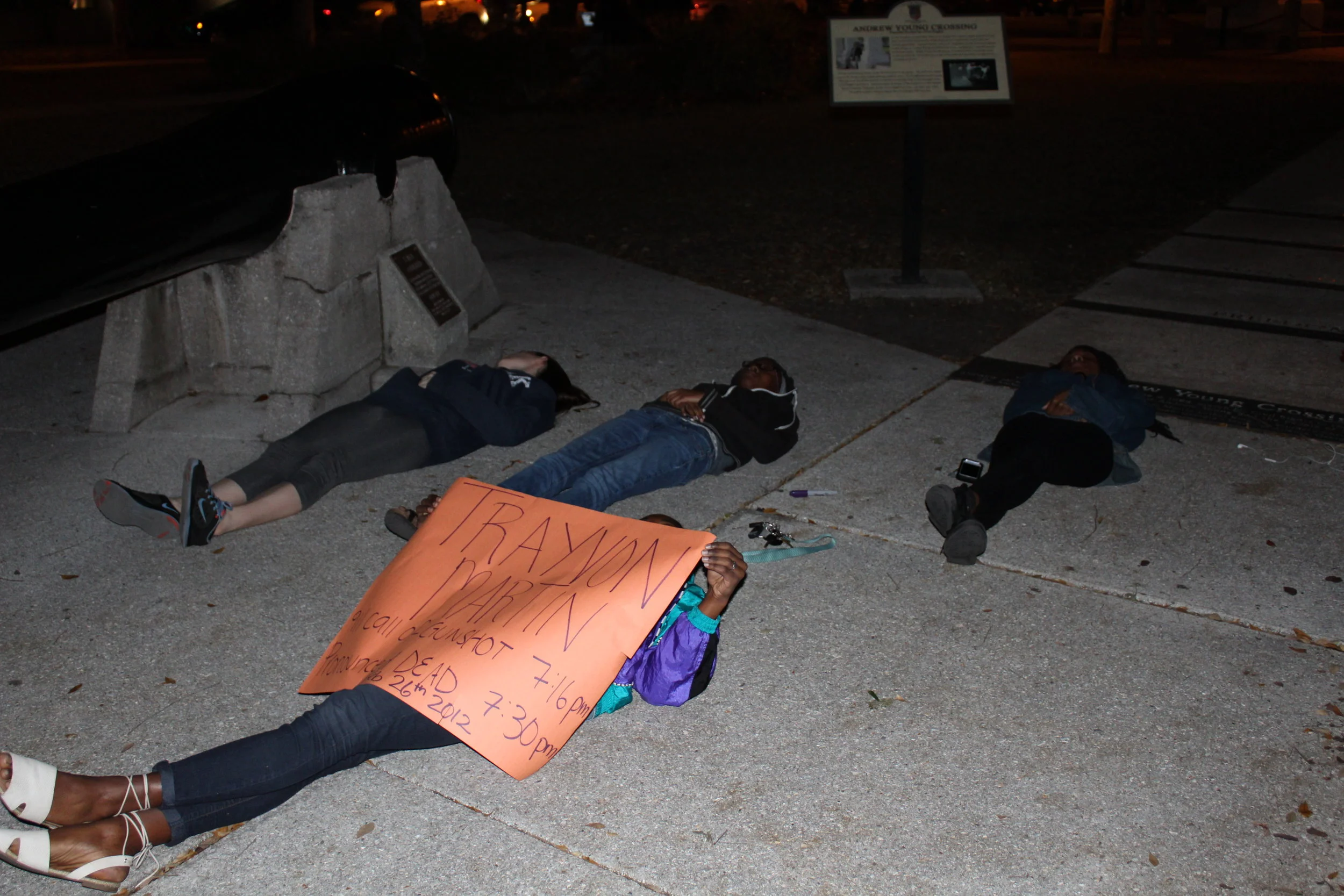
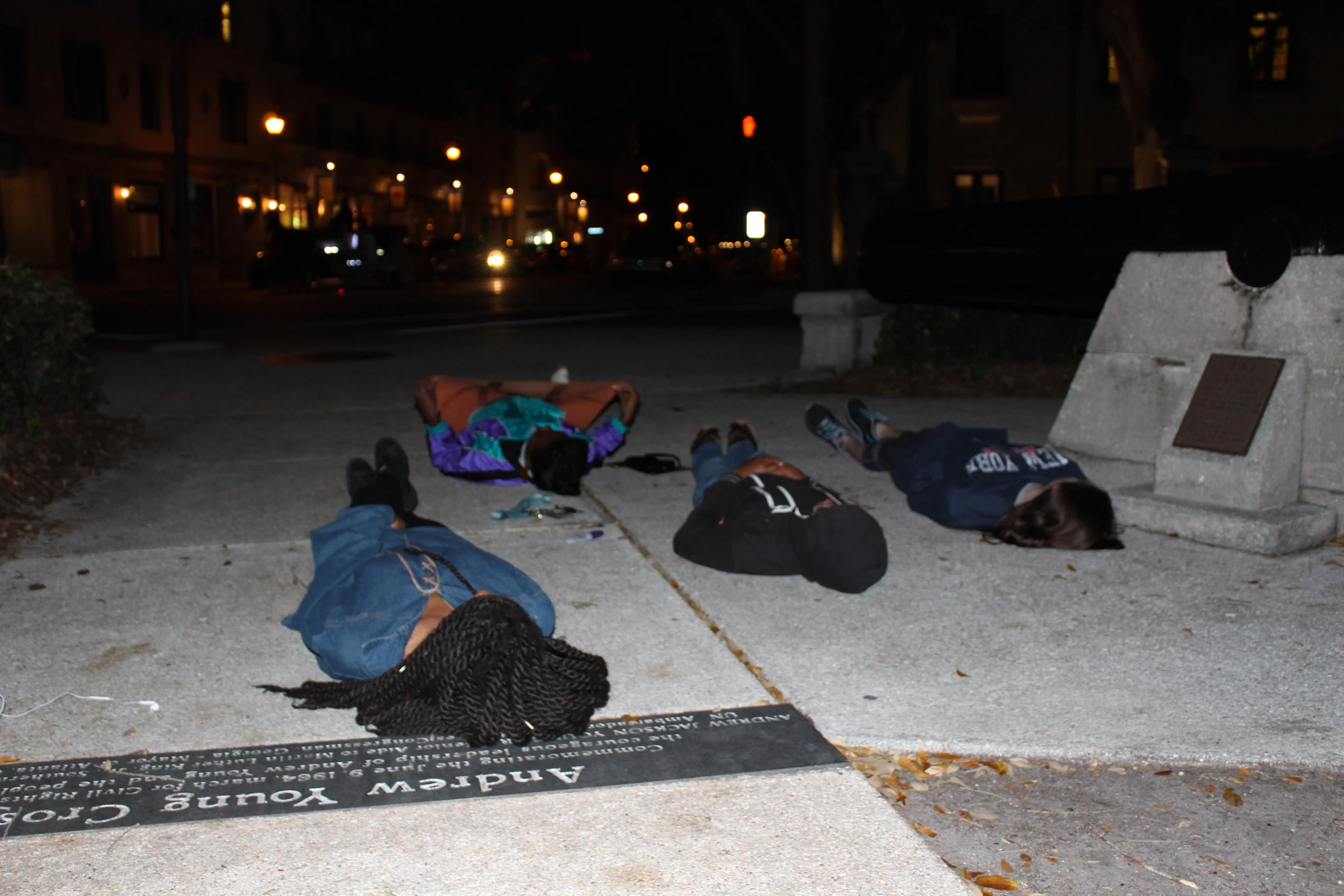
Flagler College students Hasani Malone, Becky Guerrier, Kayla Lloyd and Sam Tate lying on the ground in protest at the Andrew Young crossing in downtown St. Augustine to protest on the anniversary of Trayvon Martin’s death.
This story was originally published in the Flagler College Gargoyle
On Sunday night, four Flagler College students and a local pastor laid on the ground in downtown St. Augustine to remember the shooting of Trayvon Martin.
“We’re here to lie on the ground from the time that the 911 call was made to the time that he was pronounced dead,” said Becky Guerrier, who organized the protest.
They chose to do it for 14 minutes because that is how long Martin was on the ground from the time of the 911 call to being pronounced dead.
Becky Guerrier, Hasani Malone, and Kayla Lloyd hold up their sign that reads, “Trayvon Martin 911 call of gunshot 7:16 p.m. pronounced dead 7:30 p.m. Feb. 26 2012.”
Guerrier said she announced this protest on Facebook after learning that Sunday marked five years since his death.
“It was unjust, unfair and unfortunately someone’s life,” she said.
Trayvon Martin was 17 years old when he was shot by George Zimmerman in Sanford, Florida, while visiting his father.
“He was a 17-year-old African-American male and he was minding his own business going to the store to get himself some Arizonas [iced tea] and some Skittles, you know, like us young kids love to do,” Guerrier said. “And unfortunately the night watchmen racially profiled him, thought he was suspicious and shot him,” Guerrier said.
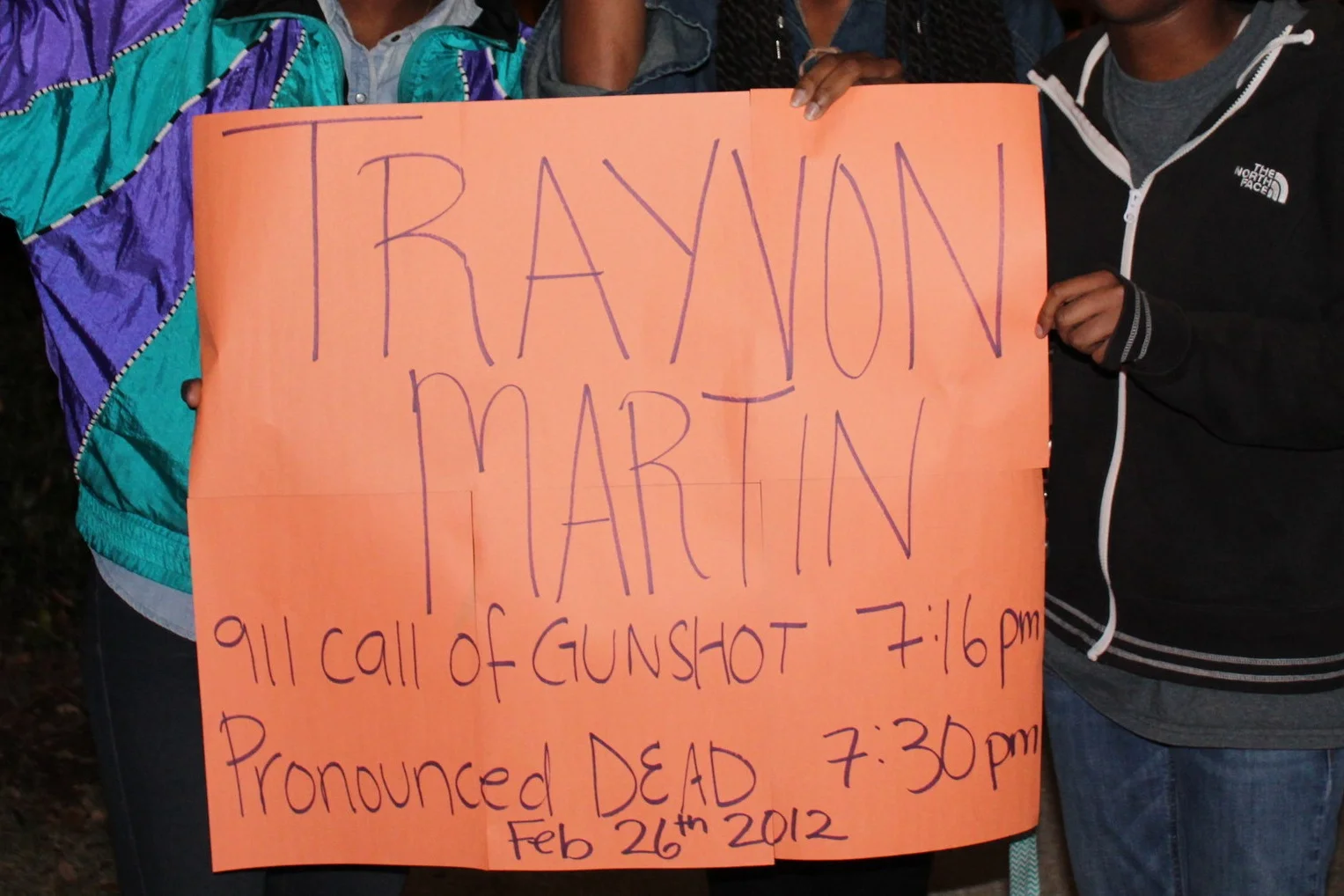
Becky Guerrier, Hasani Malone, and Kayla Lloyd hold up their sign that reads, “Trayvon Martin 911 call of gunshot 7:16 p.m. pronounced dead 7:30 p.m. Feb. 26 2012.”
After the protest, the students spoke about what this act meant to them personally.
Kayla Lloyd spoke about how this act of laying on the ground lifted a weight “off her heart.”
“I used to be ashamed of being black. I used to be very ashamed, not gonna lie. I used to say ‘God you can take that back I don’t want it anymore, have it,’ ” Lloyd said.
She said that lately, though, she has embraced it. But what she is noticing more and more is the amount of racism her and her family face.
“Lately I’ve been learning to appreciate it, celebrate it and use it,” she said. “[But] I’ve got anger towards my former friends who don’t care, they just don’t care. When I invite them to stuff they find any and every excuse in the book not to show up. I’m trying to learn how to forgive them and to move on.”
She said that back home in Tampa, her family faces a lot of racist remarks and actions as well.
“I’m angry at people who yell ‘n—a’ at my brother as he’s in our neighborhood, playing, which is what kids should be doing. I’m angry at the way my dad has to carry himself in order not to be judged in public,” she said. “I’m angry at people who say ‘we should all just move on, it’s not that big of a deal,’ because they’ve never lived it and they don’t care.”
Becky Guerrier touched on her feelings on the subject after the 14 minutes as well.
“For me it taught me, especially being Haitian, its taught me not just to categorize the race movement before like the woman movement,” Guerrier said.
She said that she had often heard that she couldn’t worry about all three at the same time. Or that people would say that once the races were equal, then she could worry about the women’s movement.
“But I can’t choose to be black and then a woman or choose to be a woman and then black,” she said. “I’m the both at the same time.”
She also said that she has learned to embrace being a woman, being an immigrant from Haiti, and being African-American altogether.
“Understanding that I don’t have to pick and choose which one I can be proactive about. But it’s three at the same time and its three things that are propelling me forward and three things to celebrate,” Guerrier said.
Hasani Malone, who also took part in the protest, said that she is proud to be African-American at a school that is mostly white.
“But even, at like, these schools, predominately white institutions, where there aren’t many black kids here, you also learn to celebrate your blackness because you’re already set apart here because of that,” she said.
She said that her experience at Flagler has been shaped, in part, by her race.
“A lot of times people pick me out in class because I’m the black kid,” she said. “And they’ll be like ‘what do you think about this?’ ”
She continued that it also extends outside of the classroom.
“A lot of times I’ll get like small micro aggressions, like small racist remarks because I’m the only black friend in my friend group or something. My friends don’t do that but the friends that I had when I first got here did,” Malone said.
Although she has had negative experiences with some of the students at Flagler, she said that she is encouraged by the strength she sees because of it.
“I had already embraced my blackness before I got to college, but it’s stronger every day,” Malone said. “Especially every day that I go through like someone racially profiling me, or somebody following me around the store, or [making] racist remarks because I remember how strong I am, and how strong everyone in my race has to be to have to go through that continuously the same way I do. It just makes you proud to be black. “
Children at the Jacksonville Women’s March

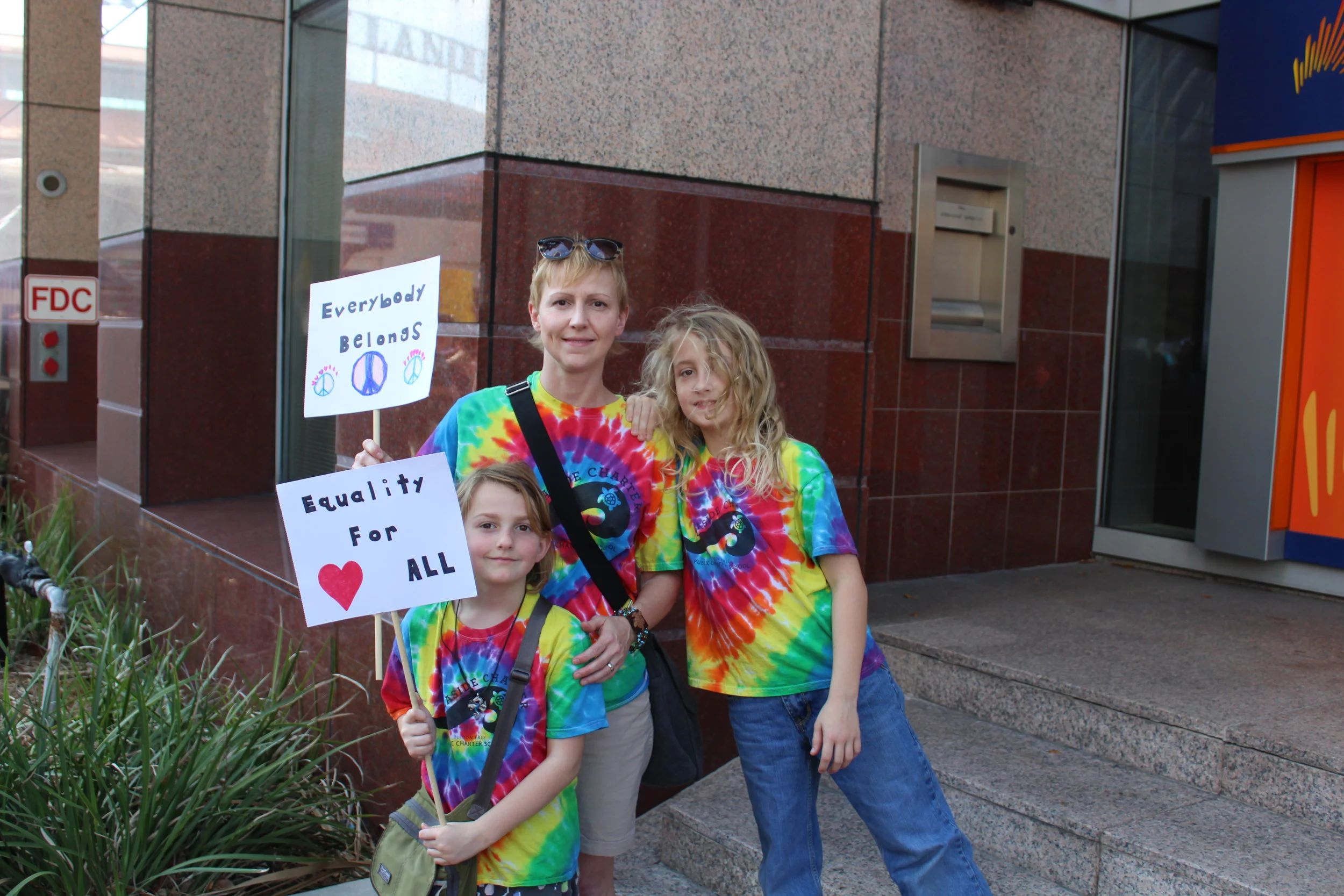
From left, Karsen and Marlee Crook on the front steps of the Jacksonville Landing.
Jacksonville, Fla—Signs read, “Well-behaved women rarely make history,” “women’s rights are human rights” and “I am not up for grabs.”
The sun shone down on the residents of Jacksonville and the surrounding areas as they chanted “Love trumps hate” with it starting in the first few rows and then trickling back row by row as more people heard the speaker behind the bullhorn.
Many of the protesters were wearing pink beanies, nicknamed “p****hats,” even though the temperature was around 80 degrees during the march.
At 1p.m. on Saturday, hundreds of men, women and children began to march for women’s rights through downtown Jacksonville.

Young woman holds up a sign that reads “teach peace” at the Jacksonville Women’s March.

The march, which started at The Jacksonville Landing, was walked by a large number of children as well as adults.
Two of those children were Gabriel and Grace Freeman, whose mother Tina Freeman brought them to protest today because she believes that “our fundamental human rights are threatened by this new administration.”

From left, Gabriel, Tina and Grace Freeman at the end of the March route.
Christine Jordan brought her son David to the march and said that she was there because there was a lack of girls interested in math and science.
She said that this was because those subjects are typically seen as something that boys should go into.

Christine and David Jordan at Hemming Park in Jacksonville.
Nicole Flaherty and her children Finn and Isla were at the march because she believes that everyone should have equal rights.
“It’s more of a positive march for us than a negative one,” she said.
From left, Isla, Nicole and Finn Flaherty at the march on Saturday.
Erica Nelson brought her daughters Eunique and Essence Devine to the march to show them that people could come together despite what they might hear.
She said that she wanted to show them that not all white people were racist.
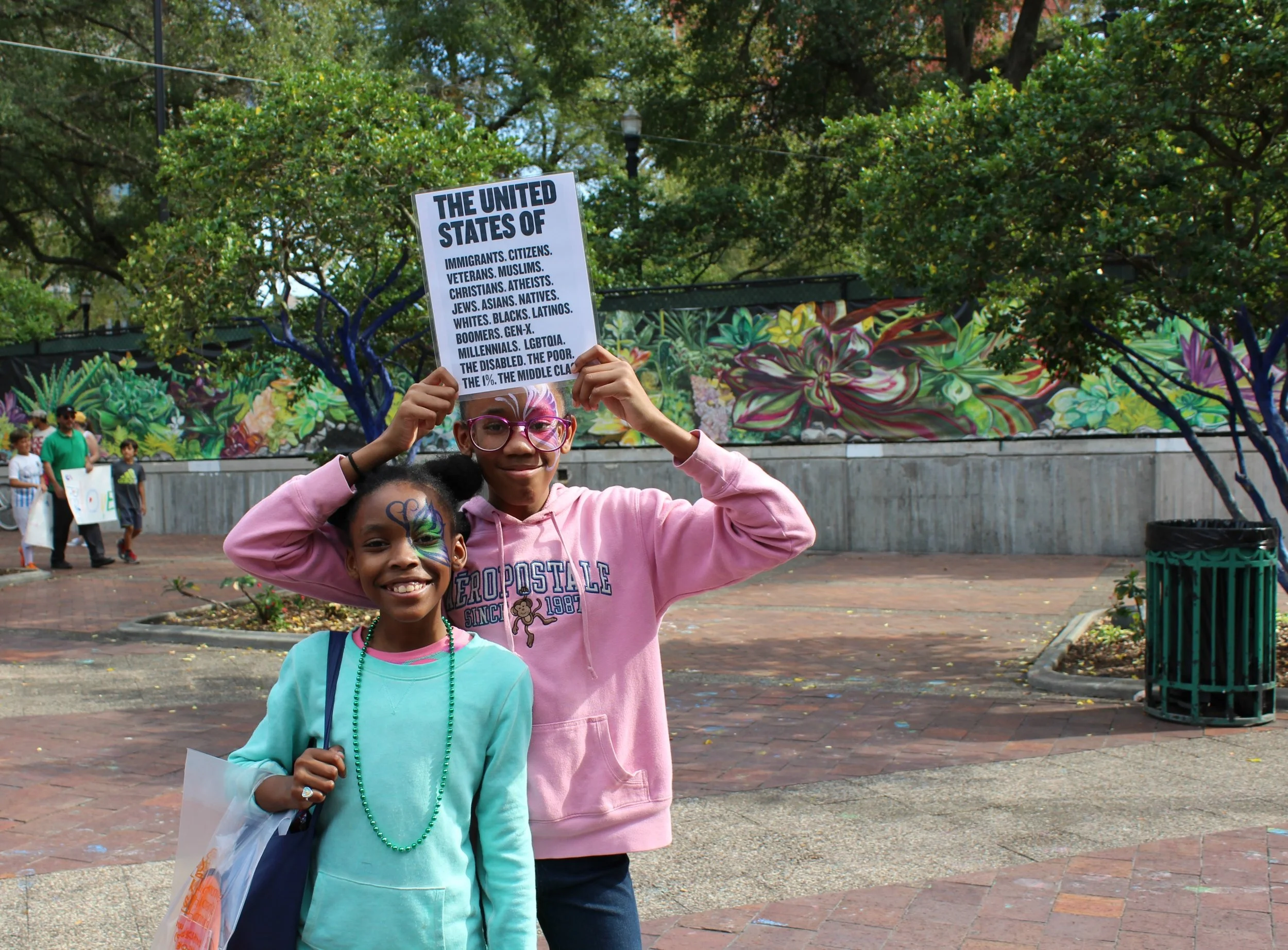
From left, Essence and Eunique Devine after the march. Their mother Erica Nelson said that it was important to her that they grow up to “have their own mind.”
Her eldest daughter, Eunique, has already faced increased bullying in schools to the point where she has to change schools.
Eunique Devine also carried a sign that read, “I’m with her” and showed a picture of the Statue of Liberty.
Many of the children and young people that attended made or helped make the signs that they carried. They ranged from current issues to messages of love and inclusivity.
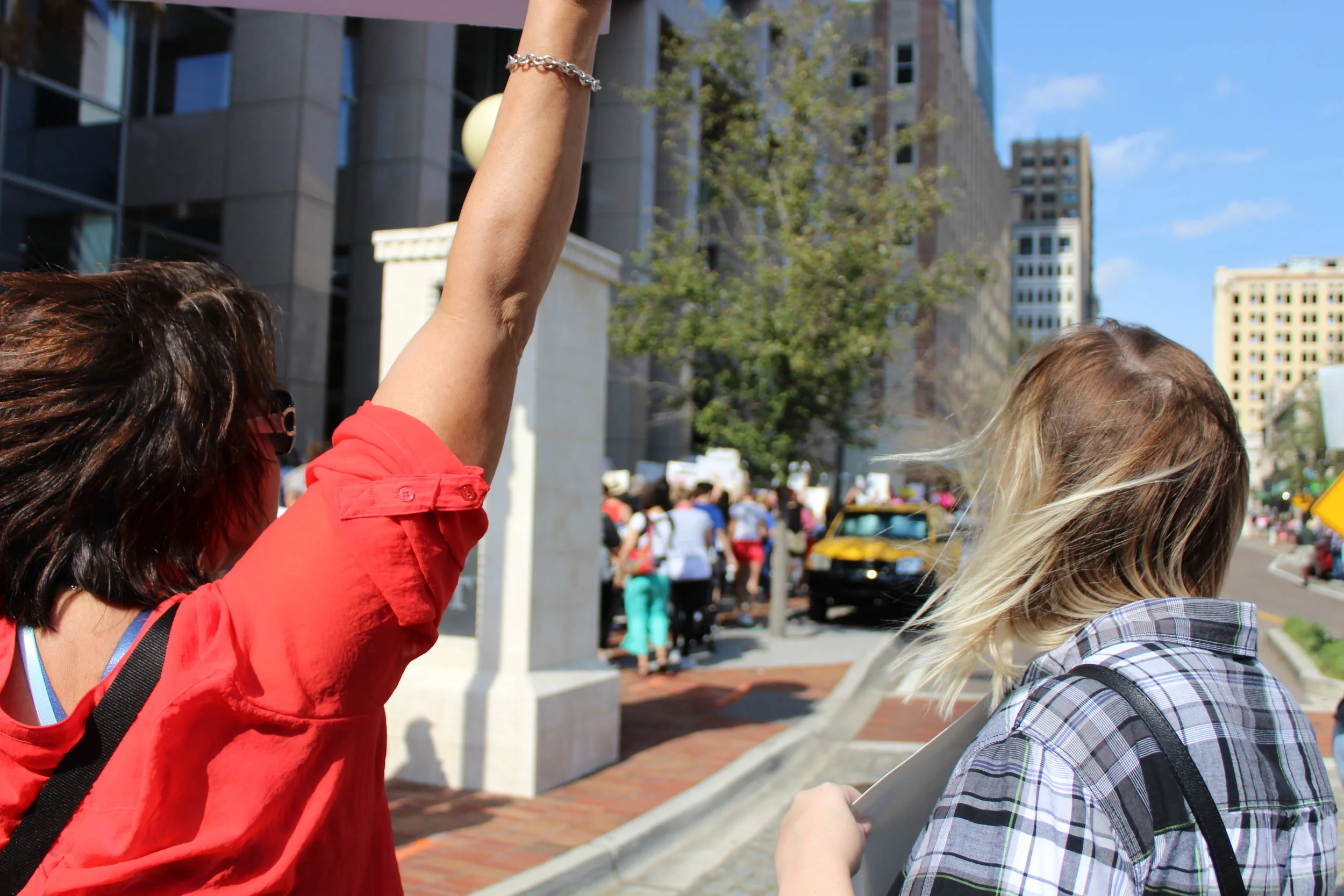
Two women begin the march towards city hall while organizers warn people to stay on the sidewalks or they will be arrested.
At 81, he wants to be oldest to sail solo, nonstop around world
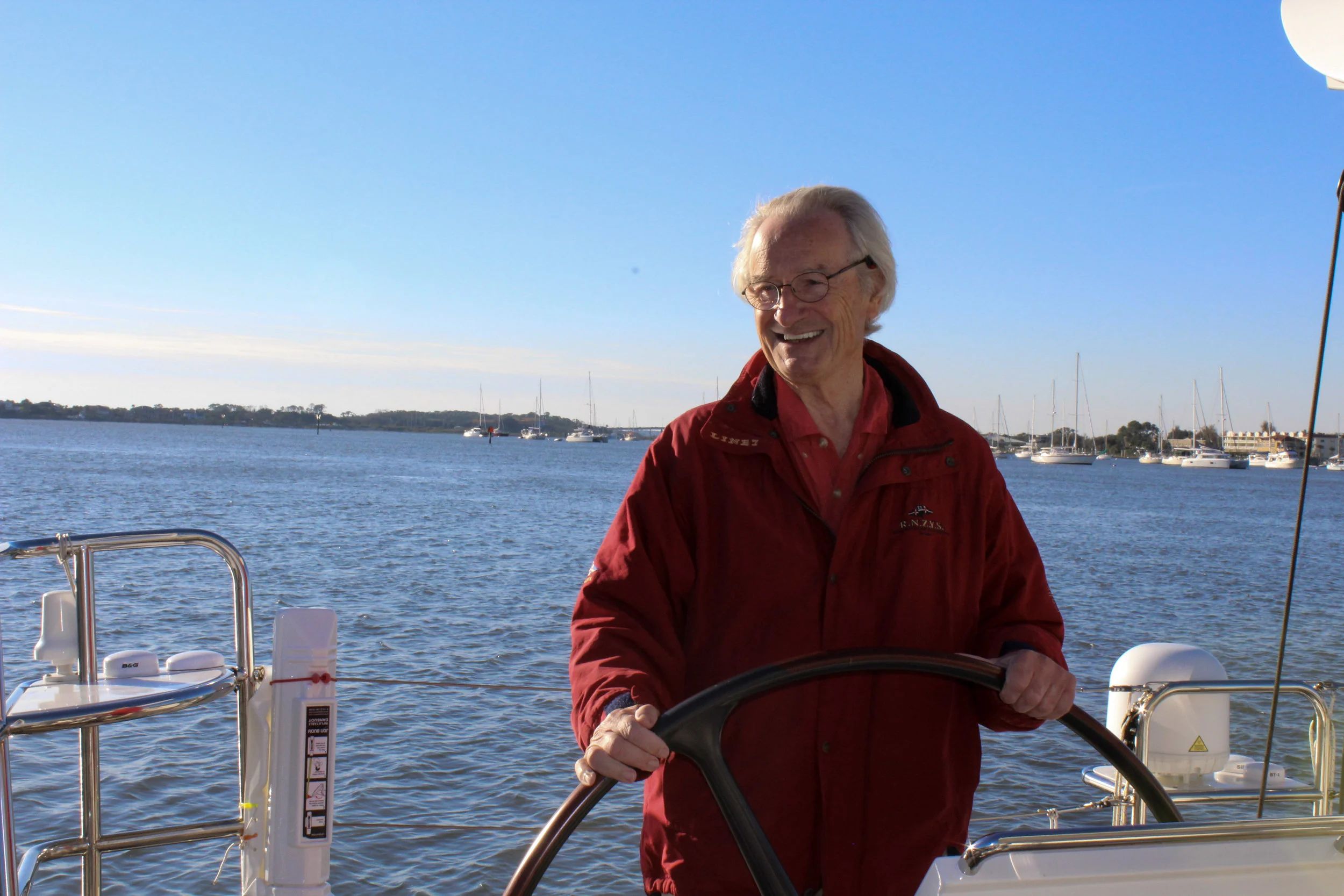
Stanley Paris on the Kiwi Spirit II. This boat, he said, would be easier for one person to navigate by themselves.
This story was originally published in the Florida Times-Union
ST. AUGUSTINE — Dr. Stanley Paris has a new boat and an old goal ready to cross the horizon.
The Kiwi Spirit II is set to depart Thursday when Paris will start his last attempt to become the oldest man to ever sail nonstop, solo around the world. He expects to go through the Bridge of Lions about 12:30 p.m.
He is 81 years old.
“The boat was designed in France [a model Finot-Conq 53] and I had it built in Germany and then I sailed it from Germany to the United States and prepared it for this event,” Paris said.
A physical therapist by profession, Paris has sailed since he was 7 years old as a part of Sea Scouts in New Zealand and lived on a sailboat in Boston Harbor for two years in the 1960s.
“In 1998, I had a boat built for me in Sweden and I went there and I sailed from Sweden back to the United States and then around the world over a period of four or five years, leaving the boat in different ports and coming home, going down with family or friends and sailing it to the next place and so, between 1998 and 2002 I went ’round the world.”
He has sailed across both the Atlantic and Pacific oceans and has visited England, Alaska, New Zealand, Australia, South Africa, and the Caribbean.
In retirement, though, he began preparing for his current goal of sailing around the world.
“I leave St. Augustine here and go around Bermuda. ... and the route will be down the Caribbean staying well away from the islands of course, getting around Brazil, then heading south to get under South Africa and then going east under South Africa and Australia, under New Zealand, under South America and then heading up north again through the south Atlantic backup to Bermuda, after rounding Brazil, after rounding Bermuda, then back into St. Augustine where I suspect if I succeed there will be quite a welcome.”
This is fourth attempt. His first boat was named the Kiwi Spirit — he is originally from New Zealand — and was 64-feet long, which made it more difficult for one person to handle.
In 2014 he started off to sail solo, nonstop around the world. He set out on the Kiwi Spirit only to realize that the fittings for the mast and sails that make everything hold fast to the boat were coming loose.
“I was getting to the southern hemisphere south of South Africa,” he said, “when the deck fittings became loose and [I] sent pictures of them to the naval architect and he said they were hopelessly too small and and I shouldn’t carry on.”
Nothing he could fix at sea, Paris motored to Cape Town.
His second attempt, in 2015, also failed when his mainsail ripped in half part-way through his trip.
“That was totally unexpected and it’s a modern high-tech fiber, so not the sort of thing you can repair at sea,” he said. “It needs heat treatment and heat sealing and you can’t do that on a boat.”
Last year, his third attempt also came to a halt near Bermuda due to the boat’s electronics not working correctly.
This time, Paris has a smaller, more agile 53-foot boat named the Kiwi Spirit II.
“The advantage of that will be, it won’t be as fast as the previous boat, but then I’ll be able to keep the sails up longer when the weather’s deteriorating.”
Sailing around the world may seem daunting, but Paris is no stranger to challenges. He has swum across the English channel, driven a VW bug from England to India, biked and ridden a motorcycle across the United States and competed in an Iron man triathlon.
He said that although his family is worried for him, they understand that it is part of his personality to take risks.
“There’s always a chance of a fatality out there,” Paris said. “People have got washed off their boats and boats have sunk but most sailors manage one way or another to get home, to get back to safety.”
At 81, however, he says that he understands that there is additional risk to this undertaking, “like having a stroke, and there’s no one to help you you’d be in pretty bad shape. And if you have a heart attack you can’t get to a hospital quickly either.”
He said that he knows the odds are against him on this trip, but he is still trying to prepare both himself and the boat to go around the world.
“The odds of success are not high,” he said, “and right now this happens to be the 50th year, the anniversary of the first person to sail around the world, and so they’re honoring that with a regatta that began in England and 18 boats started out around the world, 18.”
At the halfway point at Tasmania, Paris said, there were only eight boats left. He estimates that only five or six will make it back to England.
“So with masts breaking and keels coming off and all sorts of things the odds are against four to one against success,” he said. “It’s not a simple flip of the coin.”
He has prepared his boat with 60 days’ worth of frozen food, 60 days’ worth of canned food and 60 days’ worth of freeze-dried food in case the freezer goes out and spoils his frozen food.
“On a boat like this I hope to go round nonstop the entire way therefore, you only need one bed,” Paris said. “Although I’ve got one on each side of the boat, depending on which way the boat is leaning.”
He said that he had made other modifications to the boat, such as only having one bathroom and taking out the air conditioning.
“I had to bring in a lot of food supplies and a lot of spare parts because I’m not allowed to get any spare parts or restock food or anything like that on the trip,” he said.
His boat is set up to make the trip without running any diesel, by using solar panels to power what he needs. He said that his goal is to make it around the world while still staying “green.”
Even with all of the physical preparations, he said that mentally the trip is difficult.
Paris will only sleep for 45 to 90 minutes at a time during his trip so that he can keep an eye on the wind, weather and his sails.
“Obviously you go through quite a few emotions but you settle down. What you lose touch of is with what’s going on in the world,” he said.
He said that he even loses touch with his family to a certain extent, despite talking to his wife every week on the phone.
“She won’t be telling me things that, you know the sink is not working or the stove is broken or someone’s ill in the family because these things I can’t do anything about and it will only worry me,” he said. “So, I even become disconnected from my family, from reality and that you know is happening that adds to sort of the loneliness.”
Paris is the founding president of the University of St. Augustine for Health Sciences.
“So I just like challenges I’m very goal-oriented ... always putting first my business and family, and when I could afford or take the time I would do something adventurous like that.”
He said after this adventure, though, he might relax more in his retirement.
“I don’t know if there’s anything next. I think I’ll hang up everything,” he said. “When I finished biking across the country, which was quite a hard effort at 97 miles a day and at times quite scary — some of the roads some of the traffic. I haven’t been biking since.
“So I don’t know what will happen if I succeed with this. I know I won’t want to go sailing the following weekend.”
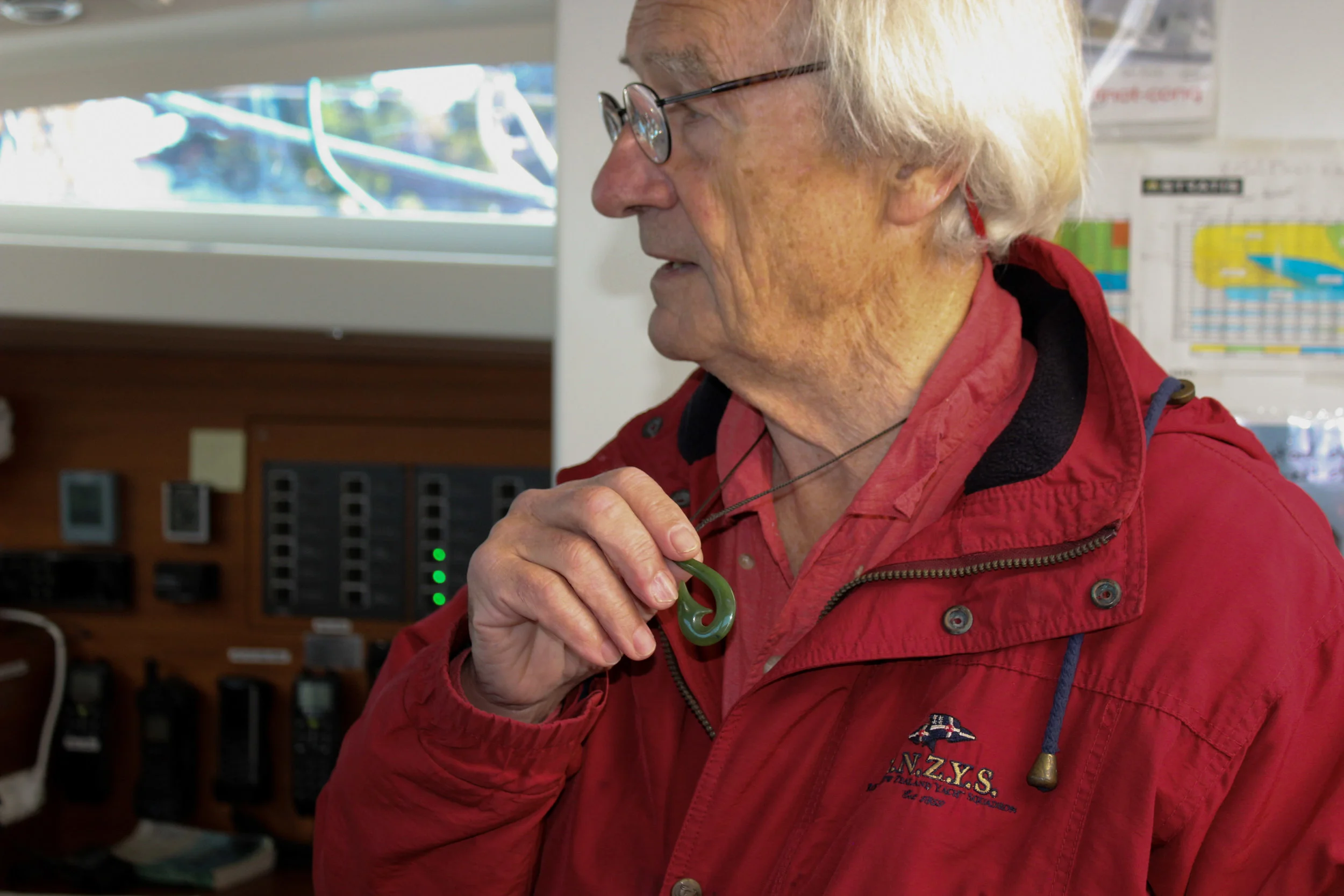
Paris holds the necklace he wears that matches the stone carving on his wall on the 53-foot Kiwi Spirit II.
I did this story in collaboration with Katie Garwood and Lauren Schroeder. They produced the video and I produced the photos and written story. I also set up the camera for the interview shot in the video.